


Survey on the Access to Finance of Enterprises in the euro area - Fourth quarter of 2025
1 Overview of the results
This report presents the main results of the 37th round of the Survey on the Access to Finance of Enterprises (SAFE) in the euro area, which was conducted between 19 November 2025 and 15 December 2025. In this survey round, firms were asked about economic and financing developments in the period between October 2025 and December 2025.[1] The sample comprised 5,067 firms in the euro area, of which 4,684 (92%) had fewer than 250 employees.[2]
The survey results indicate that bank lending conditions have tightened further since the previous wave, with firms reporting a net increase in interest rates charged on bank loans. A net 12% of firms reported an increase in bank interest rates, compared with 2% in the previous quarter (Chart 1 in Section 2). In this quarter, both large firms and small and medium-sized enterprises (SMEs) indicated an increase in interest rates in net terms (large firms 12%, from ‑3% in the previous round; SMEs 13%, from 5% in the previous round). In net terms, both large firms and SMEs reported a further slight tightening in other loan conditions related to both price and non-price factors.
An indicator of overall firms’ financing conditions constructed using firms’ responses shows a slight tightening in the fourth quarter of 2025 (Chart A in this section). The indicator reflects firms’ perceptions of price-related terms and conditions of financing, including changes in bank interest rates and other bank-related costs such as charges, fees and commissions.[3] In this survey round, the indicator confirms a slight tightening in firms’ overall financing conditions, reported to a similar extent by both SMEs and large firms.
Chart A
Change in price terms and conditions as perceived by euro area firms
(weighted scores)

Base: Firms that applied for a bank loan.
Notes: Indicator derived from factor analysis. For details of the analysis see footnote 3. The indicator is based on firm-level survey replies from the fourth quarter of 2023 to the fourth quarter of 2025, using the replies on changes in the previous three months. The aggregate indicators are the average of firm-level scores, weighted by size, economic activity and country. Positive values indicate a deterioration in firms’ financing conditions. The individual scores have a range of between -100 and 100.
Firms reported a modest rise in their needs for bank loans, accompanied by a small perceived decline in availability (Table 1, columns 2, 6 and 10 at the end of this section and Chart 2 in Section 2). In the fourth quarter of 2025, firms indicated increased needs for bank loans (net 3% compared with 0% in the previous quarter), while a net 2% of firms reported a decline in bank loan availability (up from 1% in the previous quarter). As a result, the euro area bank loan financing gap indicator – an index capturing the difference between changes in needs and availability – increased to 3% (from 1% in the previous quarter). Looking ahead, firms expect the availability of external financing to remain broadly unchanged over the next three months, as was the case in the previous survey round.
Financing from external and internal sources continued to be used primarily for fixed investment and for inventories and working capital (Chart 4 in Section 2). Fixed investment remained the most common use of financing (39% of firms), particularly among large firms, while usage among SMEs showed a slight increase (31%, up from 28%). Financing for inventories and working capital remained broadly stable (a net 37% of firms).
Firms continued to perceive the general economic outlook to be the main factor constraining the availability of external financing (Chart 6 in Section 2). In the fourth quarter of 2025, a net 20% of firms reported that a worsening in the general economic outlook had negatively affected the availability of external financing, from a net 19% in the third quarter of 2025. Firms reported a somewhat more negative impact of their firm-specific outlook on financing availability.
Firms’ perceptions of banks' willingness to lend slightly improved (Chart 7 in Section 2). On balance, 4% of firms reported an improvement in banks’ willingness to lend, up from 2% in the previous survey round. This increase was driven by both SMEs and large firms.
The share of firms applying for bank loans increased (Chart 8 in Section 2). In the fourth quarter of 2025, the share of bank loan applications increased to 23%, from 17% in the previous quarter. For firms that did not apply for bank loans, the most frequently cited reason was that they considered their internal funds to be sufficient to support their business plans.
The percentage of firms reporting obstacles to obtaining a bank loan increased slightly. 7% of firms that considered bank loans relevant for their firm faced obstacles when seeking to obtain a loan, up from 5% in the previous quarter (Table 1, columns 11 and 12 in this section and Chart 9 in Section 2).
Over the last three months, firms reported rising turnover and continue to have optimistic turnover expectations for the next quarter. The net share of firms indicating higher turnover in the fourth quarter of 2025 rose to 7%, up from 0% in the third quarter (Chart 10 in Section 3). The increase was mainly driven by large firms. Firms, especially large ones, continue to have optimistic turnover expectations for the first quarter of 2026.
Firms continued to signal a deterioration in profits. A net 10% of firms reported a decline in profits in the fourth quarter of 2025, compared with 13% in the third quarter. The decline was more widespread among SMEs than among large firms.
Over the past three months, the share of financially vulnerable firms was low, broadly unchanged since the previous quarter (Chart 11 in Section 3). Only 4% of firms experienced significant difficulties in managing their businesses and servicing their debts during this period.
Fewer enterprises reported an increase in investment over the past three months, although firms were marginally more optimistic about future developments in investment (Chart 12 in Section 3). A net 6% of firms indicated a rise in investment in the fourth quarter of 2025 (down from a net 8% in the previous quarter), broadly in line with their earlier expectations. Across size classes, the net share of SMEs reporting increased investment remained unchanged at 5%, while among large firms the net share declined to 7%, from 14% in the third quarter. Looking ahead, firms are slightly more optimistic about raising future investment than they were in the previous quarter. A net 9% of firms expect an increase in investment in the first quarter of 2026 (5% of SMEs and 16% of large firms), compared with 8% in the previous quarter.
The availability of skilled labour and production or labour costs are the major concerns limiting production (Chart 13 in Section 3). Over the past three months, the availability of skilled labour was the most widely reported major concern (signalled by 59% of firms), alongside increases in production or labour costs (59%). Firms also highlighted finding customers (51%) and competition (43%) as major concerns, signalling that trade policy uncertainty continued to affect their business decisions. Across size classes, large firms tended to be more concerned than SMEs, particularly about factors linked to ongoing uncertainty in production and distribution. By contrast, only a quarter of firms viewed access to finance as a major concern for their businesses.
The use of artificial intelligence (AI) is widespread among euro area firms, though most firms use it very infrequently or moderately. In this survey round, firms were asked about their use of AI, the reasons behind their adoption/non-adoption of it and the percentage of their total investment devoted to AI over the next twelve months. Around a quarter of firms do not yet use AI and only 7% use it to a significant extent, with non-use more common among SMEs, although the share of significant users is similar for small and large firms (Chart A in the box). Across the four largest euro area economies, Germany and Spain have the most firms using AI at least occasionally, while Italy has the highest share of non-users. AI is mainly used to improve business processes, with the main barrier to wider adoption being a lack of AI skills, followed by system incompatibilities, ethical concerns and doubts about its usefulness (Charts B and C in the box). Over the next twelve months, firms plan to devote about 9% of total investment to AI on average, with similar shares for SMEs and large firms and higher planned investment rates among current (especially intensive) AI users (Chart D in the box).
Firms’ expectations for increases in selling prices over the next twelve months remained unchanged since the previous quarter (Charts 14-16 in Section 3). Firms expect their selling prices to rise by 2.9% on average over the next 12 months, as was the case in the previous survey round. Expectations for wage increases stood at 3.1%, on average, up from 3% in the previous survey round. The expected average increase in non-labour input costs was 3.6%, down from 3.8% in the previous survey round. Across firm size classes, SMEs continued to report higher expectations for selling prices, wages and non-labour input costs than large firms.
Euro area firms’ median inflation expectations were broadly unchanged at 2.6% for the one-year horizon and at 3% for the three and five-year horizons (Chart 17 in Section 3). Median one-year-ahead inflation expectations were at 2.6% (up from 2.5%), with SMEs expecting higher inflation (2.9%) than large firms (2.4%, Chart 19). SMEs did not revise their expectations for the three-year horizon (stable at 3.1%), while large firms slightly decreased their expectations (to 2.4%, down from 2.5% in the previous survey round). SMEs slightly decreased their inflation expectations to 3.7% (down from 3.8%) for the five-year horizon, while for large firms the decrease was more pronounced (to 2.3%, from 2.7%).
Slightly more firms reported upside risks to their long-term inflation outlook compared with the previous round (Chart 19 in Section 3). In total, 56% of firms perceived upside risks to their inflation outlook five years ahead (up from 53%), 33% perceived risks to be balanced, while the share of firms seeing downside risks relative to their inflation forecast stood at 10%. For both SMEs and large firms, risks remain clearly tilted to the upside.
Table 1
Latest developments in SAFE country results for euro area firms
(net percentages, percentages of respondents)
Needs | Availability | Financing gap (bank loans) | Financing obstacles | Vulnerable firms | ||||||||||
|---|---|---|---|---|---|---|---|---|---|---|---|---|---|---|
Bank loans | Credit lines | Bank loans | Credit lines | |||||||||||
(1) | (2) | (3) | (4) | (5) | (6) | (7) | (8) | (9) | (10) | (11) | (12) | (13) | (14) | |
Q3 2025 | Q4 2025 | Q3 2025 | Q4 2025 | Q3 2025 | Q4 2025 | Q3 2025 | Q4 2025 | Q3 2025 | Q4 2025 | Q3 2025 | Q4 2025 | Q3 2025 | Q4 2025 | |
Euro area | 0 | 3 | 8 | 6 | -1 | -2 | 1 | -1 | 1 | 3 | 5 | 7 | 3 | 4 |
BE | -3 | 4 | 11 | 12 | -7 | 4 | -1 | 5 | 3 | 0 | 2 | 4 | 8 | 2 |
DE | -1 | 5 | 16 | 5 | -12 | -10 | -4 | -4 | 8 | 11 | 6 | 7 | 3 | 3 |
IE | 2 | 2 | 13 | 13 | 3 | -3 | 9 | 2 | -1 | 3 | 8 | 4 | 3 | 2 |
GR | 13 | 15 | 13 | 12 | 12 | 9 | 8 | 8 | -1 | 5 | 11 | 10 | 2 | 2 |
ES | 1 | 2 | 8 | 10 | 10 | 6 | 7 | 2 | -6 | -1 | 5 | 7 | 2 | 2 |
FR | -1 | 4 | 0 | -1 | 1 | -9 | 1 | -4 | 0 | 4 | 3 | 7 | 3 | 6 |
IT | 8 | 5 | 3 | 5 | 7 | 2 | 3 | 2 | 0 | 3 | 3 | 7 | 4 | 4 |
NL | -18 | -11 | -2 | 14 | -3 | 7 | 5 | 3 | -8 | -10 | 2 | 7 | 3 | 2 |
AT | -4 | -10 | 4 | 1 | -3 | 4 | -1 | -3 | 0 | -8 | 2 | 3 | 4 | 3 |
PT | -2 | -6 | 0 | 0 | 11 | 10 | 9 | 5 | -8 | -8 | 4 | 3 | 3 | 3 |
SK | 6 | -5 | 10 | 3 | -4 | 1 | -4 | -1 | 5 | -5 | 10 | 3 | 11 | 7 |
FI | 3 | 6 | 16 | 22 | -18 | -11 | -24 | -7 | 12 | 9 | 19 | 13 | 6 | 7 |
Notes: For the “financing gap”, see the notes to Chart 2; for “financing obstacles”, see the notes to Chart 10; for “vulnerable firms”, see the notes to Chart 12. “Q3 2025” refers to round 36 (July-September 2025) and “Q4 2025” refers to round 37 (October-December 2025). Financing obstacles and vulnerable firms refer to the percentages of respondents, while the other indicators in the table are expressed in net percentages.
2 Firms’ financing conditions
2.1 Firms reported a net tightening in the interest rates on bank loans
In this survey round, firms observed a net tightening in bank loan interest rates and a continued tightening of other loan conditions (Chart 1). In the fourth quarter of 2025 a net 12% of firms reported an increase in bank loan interest rates, compared with a net 2% in the previous quarter. Both large firms and SMEs indicated a net tightening in bank loan interest rates (for large firms a net 12%, up from 3% in the previous quarter, for SMEs a net 13%, up from 5%). Meanwhile, a net 28% of firms (up from 23% in the third quarter of 2025) reported an increase in other financing costs, such as charges, fees and commissions, and a net 14% of firms (down from 16% in the previous quarter) reported stricter collateral requirements. The share of large firms indicating stricter collateral requirements decreased (11%, down from 21% in previous quarter), while that of SMEs slightly increased (17%, up from 12%).
Chart 1
Changes in the terms and conditions of bank financing for euro area firms
(net percentages of respondents)

Base: Firms that had applied for bank loans (including subsidised bank loans), credit lines, or bank or credit card overdrafts. The figures refer to pilot 2 and rounds 30 to 37 of the survey (October-December 2023 to October-December 2025).
Notes: Net percentages are the difference between the percentage of enterprises reporting an increase for a given factor and the percentage reporting a decrease. The data included in the chart refer to Question 10 of the survey.
2.2 A modest rise in needs and a small decline in availability resulted in an increased bank loan financing gap
Firms indicated a modest rise in needs for bank loans (Chart 2). In the fourth quarter of 2025, firms reported increasing needs for bank loans (a net 3%, compared with 0% in the previous quarter), with large firms indicating increasing needs (a net 8%, from a net 3% in the previous quarter) while SMEs reported broadly unchanged needs (a net 0%, from 2% indicating decreasing needs in the previous quarter).
Firms perceived a small decrease in the availability of bank loans (Chart 2). The net percentage of firms reporting a decline in the availability of bank loans was 2% (up from 1% in the previous quarter). Both SMEs and large firms observed a small decline in the availability of bank loans (a net -2% and -3%, respectively, unchanged for SMEs and from 0% for large firms in the previous quarter). These developments are echoed by the slight net tightening of credit standards in loans or credit lines granted to firms in the fourth quarter of 2025, as highlighted in the euro area bank lending survey during the same period. Accordingly, the bank loan financing gap indicator – an index capturing the difference between changes in needs and availability – increased to 3% (up from 1% in the previous quarter). Across size classes, both SMEs and large firms indicated that their needs exceeded bank loan availability, resulting in a positive financing gap indicator of 2% for SMEs and 6% for large firms.
Chart 2
Changes in euro area firms’ financing needs and the availability of bank loans
(net percentages of respondents)

Base: Firms for which the instrument in question is relevant (i.e. they have used it or considered using it). Respondents replying “not applicable” or “don’t know” are excluded. The figures refer to pilot 2 and rounds 30 to 37 of the survey (October-December 2023 to October-December 2025).
Notes: The financing gap indicator combines both financing needs and the availability of bank loans at firm level. The indicator of the perceived change in the financing gap takes a value of 1 (-1) if the need increases (decreases) and availability decreases (increases). If firms perceive only a one-sided increase (decrease) in the financing gap, the variable is assigned a value of 0.5 (-0.5). A positive value for the indicator points to a widening of the financing gap. Values are multiplied by 100 to obtain weighted net balances in percentages. The data included in the chart refer to Questions 5 and 9 of the survey.
Firms reported increasing needs for trade credit – more so than in the previous quarter – with almost unchanged availability (Chart 3). A net 7% of companies reported a higher need for trade credit, up from a net 1% in the previous quarter. At the same time, a net 1% of firms (down from 2% in the previous quarter) signalled increased trade credit availability.
Firms reported an increased need for credit lines, while availability remained broadly unchanged (Chart 3). In this survey round, a net 6% of firms reported an increased need for credit lines (down from a net 8% in the third quarter of 2025), while continuing to signal broadly unchanged credit line availability (a net -1% from a net 1% in the previous quarter).
Chart 3
Changes in euro area firms’ financing needs and the availability of trade credit and credit lines
(net percentages of respondents)

Base: Firms for which the instrument in question is relevant (i.e. they have used it or considered using it). Respondents replying “not applicable” or “don’t know” are excluded. The figures refer to pilot 2 and rounds 30 to 37 of the survey (October-December 2023 to October-December 2025).
Notes: For a description of the indicator, see the notes to Chart 2. The data included in the chart refer to Questions 5 and 9 of the survey.
2.3 Firms used financing primarily for fixed investment and for inventories and working capital
Financing from external and internal sources continued to be used primarily for fixed investment, as well as for inventories and working capital (Chart 5). Fixed investment remained the most common purpose of financing, cited by 39% of firms, unchanged from the previous quarter. This was followed by inventories and working capital, as reported by 37% of firms, unchanged from the previous survey round. Large firms were more likely to use financing for fixed investment, with their share decreasing slightly (from 57% to 53%) compared with the previous survey round. By contrast, the share of SMEs using financing for fixed investment increased slightly (from 28% to 31%). The proportion of firms using financing for inventories and working capital remained broadly stable, suggesting no major supply bottlenecks.
Chart 4
Purpose of financing as reported by euro area firms
(percentages of respondents)

Base: All firms. The figures refer to rounds 35 to 37 of the survey (April-June 2025 to October-December 2025).
Note: The data included in the chart refer to Question 6A of the survey.
2.4 Firms expect the availability of external financing to remain broadly unchanged
Looking ahead, firms expect the availability of external financing to remain broadly unchanged over the next three months, as was the case in the previous survey round (Chart 5). A net 1% of firms anticipate deteriorating access to bank loans (from 0% in the previous quarter), while a net 1% foresee lower availability of credit lines (from 1% expecting an increase in the previous quarter). Availability for trade credit is expected to be unchanged (after a net 1% expecting an increase in the previous quarter). Large firms are more pessimistic than SMEs about the availability of bank loans and trade credit.
Chart 5
Changes in euro area firms' expectations regarding the availability of financing
(net percentages of respondents)

Base: Firms for which the instrument in question is relevant (i.e. they have used it or considered using it). The figures refer to pilot 2 and rounds 30 to 37 of the survey (October-December 2023 to October-December 2025).
Notes: See the notes to Chart 1. The data included in the chart refer to Questions 9 and 23 of the survey. The expectation line has been shifted forward by one period to allow for direct comparison with realisations.
2.5 Enterprises perceived the general economic outlook as weighing on the availability of external finance
Firms continued to view the general economic outlook as the main factor constraining the availability of external financing (Chart 6). In the fourth quarter of 2025, a net 20% of firms reported that a worsening general economic outlook had negatively affected the availability of external financing, compared with a net 19% in the third quarter of 2025. SMEs remained more pessimistic than large firms, with a net 22% citing a negative impact from the general economic outlook (up from 20% in the previous quarter), compared with a net 18% among large firms (unchanged). At the same time, a net 7% of firms indicated that the impact of their firm-specific outlook, in terms of sales and profits, on the availability of external financing was worsening (up from 6% in the previous survey round). By firm size, SMEs (a net 7%) and large firms (a net 5%) both reported a less favourable firm-specific business outlook, reflecting a slightly more pessimistic assessment than in the previous quarter. Firms continued to signal an improvement in the impact of their capital position (a net 8%, unchanged since the previous quarter) and their creditworthiness on the availability of external financing (a net 11%, down slightly from 13% in the previous quarter), mainly reported by large firms (Chart 7).
Chart 6
Changes in factors that have an impact on the availability of external financing for euro area firms (general economic outlook, firm-specific outlook and firms’ own capital)
(net percentages of respondents)

Base: All firms. The figures refer to pilot 2 and rounds 30 to 37 of the survey (October-December 2023 to October-December 2025).
Notes: See the notes to Chart 1. The data included in the chart refer to Question 11 of the survey.
Firms reported slight improvements in banks’ willingness to lend (Chart 7). On balance, 4% of firms reported an improvement in banks’ willingness to lend, up from 2% in the previous quarter. A net 4% of SMEs (up from 3%) and a net 5% of large firms (up from 0%) reported an improvement in banks’ attitudes towards them. Firms were also more optimistic about the willingness of business partners to provide trade credit (a net 6%, up from a net 4% in the previous survey round). In the current survey round, a net 7% of SMEs and 4% of large firms reported an improvement in their perception of the willingness of their trading partners to provide credit. These figures were slightly higher than in the previous quarter (a net 4% and 3% respectively).
Chart 7
Changes in factors that have an impact on the availability of external financing for euro area firms (firm’s credit history, willingness of banks to lend and willingness of suppliers to provide trade credit)
(net percentages of respondents)

Base: All firms. For the category “willingness of banks to lend”, firms for which at least one bank financing instrument (credit line, bank overdraft, credit card overdraft, bank loan or subsidised bank loan) is relevant. The figures refer to pilot 2 and rounds 30 to 37 of the survey (October-December 2023 to October-December 2025).
Notes: See the notes to Chart 1. The data included in the chart refer to Question 11 of the survey.
2.6 Bank loan applications increased, with financing obstacles slightly increased
The share of firms that reported having applied for bank loans increased compared with the previous survey round (Chart 8). In the fourth quarter of 2025, the share of bank loan applications increased to 23%, from 17% in the previous quarter. The increase was broadly based across firm sizes, with applications increasing to 17% among SMEs (up from 15% in the previous survey round) and to 30% among large firms (up from 22%). For firms that did not apply for bank loans, the main reason continued to be the availability of sufficient internal funds to finance business plans, reported by 48% of firms (down from 55% in the previous survey round). This pattern was consistent across firm sizes.
Chart 8
Applications for bank loans by euro area firms
(percentages of respondents)

Base: Firms for which bank loans (including subsided bank loans) are relevant. The figures refer to pilot 2 and rounds 30 to 37 of the survey (October-December 2023 to October-December 2025).
Notes: The data included in the chart refer to Question 7A of the survey.
The share of firms reporting obstacles to obtaining a bank loan increased slightly (Chart 9). 7% of firms that considered bank loans to be relevant for their enterprise faced obstacles when seeking to obtain a loan (5% in the previous quarter). Discouraged borrowers (i.e. firms that did not apply for bank loans even if they needed them) continued to account for the largest share of firms facing financing obstacles (4%, up from 3% in the previous quarter). SMEs reported higher levels of discouragement than large firms, while the latter more frequently cited borrowing costs as being too high.
Chart 9
Obstacles to obtaining a bank loan
(percentages of respondents)

Base: Firms for which bank loans (including subsidised bank loans) are relevant. The figures refer to pilot 2 and rounds 30 to 37 of the survey (October-December 2023 to October-December 2025).
Notes: Financing obstacles are defined here as the total of the percentages of firms reporting (i) loan applications that resulted in an offer that was declined by the enterprise because the borrowing costs were too high, (ii) loan applications that were rejected, (iii) a decision not to apply for a loan for fear of rejection (discouraged borrowers), and (iv) loan applications for which only a limited amount was granted. The data included in the chart refer to Questions 7A and 7B of the survey.
3 The economic situation of euro area firms
3.1 Firms reported higher turnover, while cost pressures remained elevated
Over the last three months, on balance, enterprises reported an increase in turnover (Chart 10). The net share of firms indicating higher turnover in the fourth quarter of 2025 rose to 7%, up from 0% in the third quarter. This was mainly driven by large firms, where the net balance increased to 14% (up from 5% previously). SMEs also reported an improvement, with a net 2% indicating higher turnover, compared with -4% in the previous quarter. Looking ahead to the next quarter, firms remain optimistic, though less so than in the previous round. A net 18% expect higher turnover, down from 25% in the previous survey round, with a net 14% among SMEs and 25% among large firms (previously 19% and 36% respectively).
Despite the pickup in turnover, firms continued to signal deteriorating profits in the fourth quarter of 2025. On balance, 10% of euro area firms reported lower profits, down from 13% in the previous quarter. The decline was more pronounced among SMEs, with a net 13% reporting lower profits (compared with 17% in the previous quarter), versus a net 6% of large firms (down from 7%).
Cost pressures related to materials, energy and labour intensified further compared with the previous quarter. A net 50% of firms reported higher labour costs (up from 42% in the third quarter), while a net 52% experienced higher material and energy costs (up from 41%). These cost increases were broadly based across firm sizes.
Interest expenses also rose. On balance, 6% of firms reported higher interest expenses, driven mainly by SMEs (9%), while on balance large firms reported no change.
Chart 10
Changes in the economic situation of euro area firms
(net percentages of respondents)

Base: All firms. The figures refer to pilot 2 and rounds 30 to 37 of the survey (October-December 2023 to October-December 2025).
Notes: See the notes to Chart 1. The data included in the chart refer to Questions 2 and 26 of the survey.
Over the past three months, the share of financially vulnerable enterprises remained low, broadly unchanged from the previous quarter (Chart 11). According to the financial vulnerability indicator, which assesses firms’ overall financial health, 4% of euro area firms reported significant difficulties in managing operations or servicing debt, up from 3% in the previous quarter.[4] Vulnerability was slightly higher among SMEs (4%) than among large firms (3%). Over the same period, the share of financially resilient firms – those better able to withstand adverse shocks – was 4%, down 1 percentage point from the previous quarter.
Chart 11
Vulnerable and financially resilient firms in the euro area
a) Vulnerable firms
(percentages of respondents)

b) Financially resilient firms
(percentages of respondents)

Base: All enterprises. The figures refer to pilot 2 and rounds 30 to 37 of the survey (October-December 2023 to October-December 2025).
Notes: For a definition of “vulnerable firms” and “resilient firms”, see footnote 4. The data included in the chart refer to Question 2 of the survey.
3.2 Investment activity slowed, with some improvement expected in the first quarter of 2026
Fewer enterprises reported an increase in investment over the past three months (Chart 12). In the fourth quarter of 2025, a net 6% of firms indicated increased investment in fixed assets, down from a net 8% in the previous quarter. While the net share of SMEs reporting a higher level of investment remained unchanged at 5%, fewer large firms reported increased investment – a net 7%, compared with 14% in the third quarter. Looking ahead, firms are marginally more optimistic about future investment than in the previous quarter. A net 9% of firms, up from 8% previously, expect to increase investment in the first quarter of 2026 (5% of SMEs and 16% of large firms).
Chart 12
Changes in realised and expected fixed investments of euro area enterprises
(net percentages of respondents)

Base: All firms. The figures refer to pilot 2 and rounds 30 to 37 of the survey (October-December 2023 to October-December 2025).
Notes: See the notes to Chart 1. The bars refer to developments over the preceding three months and the lines to expectations over the next three months. The data included in the chart refer to Questions 2 and 26 of the survey. The question on expected investments was first included in the questionnaire covering the second and third quarters of 2023.
3.3 Euro area enterprises remained concerned about the cost of production and availability of skilled labour
Firms reported that the availability of skilled labour and production or labour costs are the major constraints on production (Chart 13). Over the past three months, the availability of skilled labour or experienced managers was the most frequently cited major concern (defined as a score of at least seven on a scale of one to ten), reported by 59% of euro area firms, alongside production or labour costs (also 59%). Firms were also concerned about finding customers (51%) and about competition (43%). Across size classes, large firms tended to be more concerned than SMEs, particularly about factors linked to ongoing uncertainty in production and distribution. For example, 65% of large firms identified production or labour costs as a major issue, compared with 55% of SMEs, while 50% of large firms cited competition as a concern, versus 39% of SMEs.
A relatively low share of firms reported access to finance as a major concern for their businesses. In this survey round around 25% of firms reported access to finance as a major concern for their businesses, with similar shares across large firms and SMEs.
Chart 13
Major concerns limiting production faced by euro area firms
(over the preceding six months; percentages of respondents)

Base: All firms. The figures refer to round 37 of the survey (October-December 2025).
Notes: A “major concern” is defined as a problem scoring at least seven on a scale of one to ten. The data included in the chart refer to Question 0b of the survey.
Box 1
Adoption of artificial intelligence technologies by euro area firms: motivation and future investment plans
This box presents the results of ad hoc questions on euro area firms’ use of and expected investment in artificial intelligence (AI) technologies. The survey first asked firms about the intensity of their use of AI – including predictive tools (such as text mining, voice and image recognition and machine learning), generative tools (such as chatbots and text/image generation) and robotic process automation – and the reasons for using or not using these technologies. Firms were then asked to indicate the percentage of their total investment they expect to devote to AI over the next twelve months.[5]
The survey results show that 27% of euro area firms are not yet using AI, while 33% use it very infrequently, 31% use it moderately and 7% use it significantly (Chart A). It is more frequent for SMEs not to use AI technologies than for large firms (35% and 13% respectively) and SMEs are also less likely to experiment with AI or use it moderately than large firms. The share of firms significantly using AI is the same across SMEs and large firms, indicating that AI use is spreading among a core set of small firms.
Across countries, 47% of German and 43% of Spanish firms use AI technologies moderately or significantly, compared with 26% of firms in Italy and 22% in France. Notably, Italy has the highest share of firms not currently using AI (45%), surpassing France, Spain and Germany, which reported similar shares (27%, 26% and 23% respectively).[6]
Chart A
Use of AI by firm size and country
(percentages of respondents)

Base: All firms. The figures refer to round 37 of the survey (October-December 2025).Notes: The chart shows the weighted share of firms by the intensity of AI use, for all firms, by size class and by country. The data included in the chart refer to Question QA1_2025Q4 of the survey.
Firms primarily use AI to enhance their core and non-core business processes, accounting for 33% and 29% of usage respectively (Chart B). Significantly fewer firms cite reducing personnel costs, supporting R&D and innovation, or expanding their product and service offerings as key reasons for adopting AI (15%, 13% and 10% respectively). Regardless of the extent to which they have adopted AI, firms tend to consistently cite similar reasons for its implementation.
Chart B
Reasons for using AI
(percentages of respondents)

Base: Firms which use AI very infrequently, moderately or significantly. The figures refer to round 37 of the survey (October-December 2025).
Notes: The chart shows the weighted share of firms by reasons for using AI, also by usage intensity. The data included in the chart refer to Questions QA1_2025Q4 and QA2_2025Q4 of the survey.
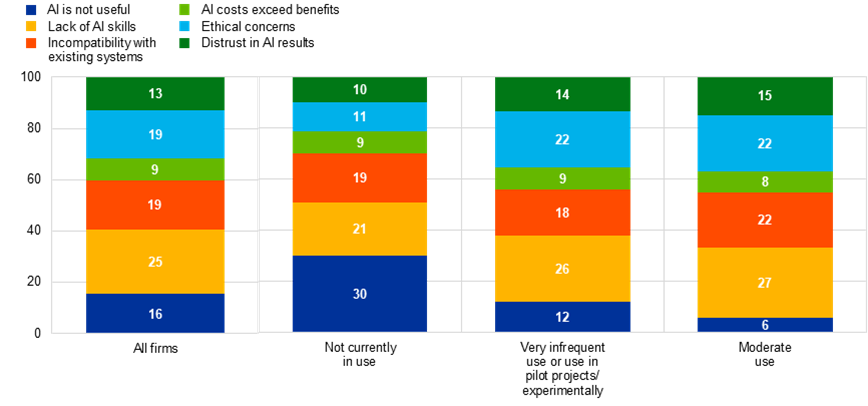
The most common reason firms cite for not adopting AI is a lack of AI skills, mentioned by 25% of respondents (Chart C). Additionally, some firms point to incompatibility with existing systems, ethical concerns or a perceived lack of usefulness of AI (19%, 19% and 16% respectively). Fewer firms express distrust in AI-generated results or believe that the costs of AI outweigh its benefits (13% and 9% respectively). A large share of firms not currently using AI indicate that AI is not useful for their business (30%), while this is much less prevalent among those firms which use AI very infrequently or moderately (12% and 6% respectively). For firms using AI to some extent, a lack of AI skills remains the most frequently cited barrier, with 26% of infrequent users and 27% of moderate users highlighting this challenge. Moreover, firms using AI infrequently or moderately are more concerned about ethical issues related to AI compared with firms that do not use AI at all (22% versus 11%).
Chart C
Reasons for not using AI more intensively
(percentages of respondents)
Base: Firms which do not use AI or use AI very infrequently or moderately. The figures refer to round 37 of the survey (October-December 2025).
Notes: The chart shows the weighted share of firms by reasons given for not using AI (more intensively), also by usage intensity. The data included in the chart refer to Questions QA1_2025Q4 and QA3_2025Q4 of the survey.
Over the next year, firms anticipate allocating, on average, 9% of their total investment to AI (Chart D). The AI investment rate is similar among SMEs and large firms (9% versus 10%). Across countries, planned AI investment as a share of total investment over the next twelve months is the largest in Germany, followed by Spain, Italy and France (10%, 9%, 8% and 7% respectively).
Chart D
Expected AI investment over the next twelve months
(percentages of overall investment)

Base: All firms. The figures refer to round 37 of the survey (October-December 2025).
Notes: The chart shows the weighted expected AI investment to total investment over the next twelve months. The data included in the chart refer to Question QA4_2025Q4 of the survey.
Even firms that do not currently use AI generally expect to invest in AI to some extent over the next twelve months, with large firms showing a slightly higher expected investment rate than SMEs (6% for large firms and 4% for SMEs, resulting in an overall average of 4%). Firms that use AI very infrequently or moderately expect higher AI investment rates (9% and 11% respectively), while the largest investment rates are expected by firms that already use AI significantly. Among significant AI users, SMEs are expecting to allocate a higher proportion of their investment to AI compared with large firms (21% versus 17%), suggesting that some SMEs are at the forefront of AI adoption.
Chart E
Expected investment in AI over the next twelve months by current AI usage intensity
(percentages of overall investment)

Base: All firms. The figures refer to round 37 of the survey (October-December 2025).
Notes: The chart shows the weighted expected AI investment to total investment over the next twelve months by current AI usage intensity. The data included in the chart refer to Questions QA1_2025Q4 and QA4_2025Q4 of the survey.
3.4 Firms’ selling price expectations remained unchanged
Firms’ expectations for increases in selling prices over the next twelve months remained unchanged from the previous quarter (Chart 14). Firms expect their selling prices to rise by 2.9%, on average, over the next 12 months, as was the case in the previous survey round. The dispersion of selling price expectations remains stable, with almost one-third of firms in the survey not expecting prices to increase over the next year.[7] Expectations for wage increases stand at 3.1%, on average, up from 3% in the previous survey round.
Chart 14
Expectations for selling prices, wages, input costs and employees one year ahead
(percentage changes over the next 12 months)

Base: All firms. The figures refer to pilot 2 and rounds 29 to 37 (September 2023 to December 2025) of the survey, with firms’ replies collected in the last month of the respective survey waves.
Notes: Mean and median euro area firm expectations of changes in selling prices, wages of current employees, non-labour input costs and number of employees for the next 12 months, along with interquartile ranges, using survey weights. The statistics are computed after trimming the data at the country-specific 1st and 99th percentiles. The data included in the chart refer to Question 34 of the survey.
Firms reported somewhat lower expectations for growth in their non-labour input costs over the next year (Chart 15). The expected average increase in non-labour input costs is 3.6%, down from 3.8% in the previous survey, while the interquartile range has remained unchanged since the previous survey round.
On average, firms expect employment to increase by 1% over the next year, while the median firm expects zero growth (Chart 15). The average expected employment growth was the same as the previous round (0.9%). The interquartile range of expected changes in staffing levels was unchanged.
Across firm size classes, SMEs continued to report higher expectations for selling prices, wages and non-labour input costs than large firms (Chart 15). On average, SMEs expect greater increases than large firms, both in their selling prices (3.2%, compared with 2.3% for large firms) and in non-labour input costs (4.2%, compared with 2.6% for large firms). SMEs’ expectations for wage costs over the next year stand at 3.4%, slightly higher than the figure of 3.2% reported in the previous survey round, while for large firms the figure is 2.6%, as in the previous quarter. Employment growth expectations for the next 12 months remained unchanged for SMEs and increased slightly for large firms since the last survey round (constant at 1% and 0.9% from 0.7% respectively).
Chart 15
Expectations for selling prices, wages, input costs and employees one year ahead, by size class
(percentage changes over the next 12 months)

Base: All firms. The figures refer to pilot 2 and rounds 29 to 37 (September 2023 to December 2025) of the survey, with firms’ replies collected in the last month of the respective survey waves.
Notes: Weighted average euro area firm expectations of changes in selling prices, wages of current employees, non-labour input costs and number of employees for the next 12 months, using survey weights. The statistics are computed after trimming the data at the country-specific 1st and 99th percentiles. The data included in the chart refer to Question 34 of the survey.
Comparing developments across sectors, firms in the services and trade sectors expect larger selling price increases than firms in construction and industry over the next 12 months (Chart 16). Firms in the services sector expect their selling prices to rise by 3.3%, similar to firms in the trade sector (3.2%), over the next 12 months. Firms in the construction sector expect an average rise of 2.8% while firms in the industry sector expect a rise of 1.6%. Wages are expected to grow by 3.4% in the services sector, 3.1% in construction, 2.9% in trade and 2.7% in industry. Firms in the construction sector expect non-labour input costs to grow by 4.5% over the next 12 months, while the figures are 3.9% for trade, 3.8% for services and 2.8% for industry. Expected increases in employment growth were slightly larger in the services sector and in construction, while they were more modest in industry and trade.
Chart 16
Average expectations for selling prices, wages and input costs one year ahead, by sector
(percentage changes over the next 12 months)

Base: All firms. The figures refer to pilot 2 and rounds 29 to 37 (September 2023 to December 2025) of the survey, with firms’ replies collected in the last month of the respective survey waves.
Notes: Mean euro area firm expectations of changes in selling prices, wages of current employees, non-labour input costs and number of employees for the next 12 months, along with interquartile ranges, using survey weights. The statistics are computed after trimming the data at the country-specific 1st and 99th percentiles. The data included in the chart refer to Question 34 of the survey.
3.5 Firms’ inflation expectations were broadly unchanged
Euro area firms’ median inflation expectations were broadly unchanged over all horizons, at 2.6% for the one-year horizon and 3% for the three and five-year horizons (Chart 17). Median one-year-ahead inflation expectations were 2.6% (up from 2.5%), with SMEs expecting higher inflation (2.9%) than large firms (2.4%). (Chart 18). SMEs did not revise their expectations for the three-year horizon (stable at 3.1%), while large firms slightly decreased their expectations (to 2.4%, down from 2.5% in the previous survey round). SMEs slightly decreased their inflation expectations to 3.7% (down from 3.8%) for the five-year horizon, while for large firms the decrease was more pronounced (to 2.3%, down from 2.7%).
Chart 17
Firms’ expectations for euro area inflation at different horizons
(annual percentages)

Base: All firms. The figures refer to pilot 2 and rounds 30 to 37 of the survey (December 2023 to December 2025).
Notes: Survey-weighted median, mode and interquartile ranges of firms’ expectations for euro area inflation in one year, three years and five years. Quantiles are computed by linear interpolation of the mid-distribution function. The statistics are computed after trimming the data at the country-specific 1st and 99th percentiles. The data included in the chart refer to Question 31 of the survey.
Chart 18
Firms’ median expectations for euro area inflation by size class
(annual percentages)

Base: All firms. The figures refer to pilot 2 and rounds 30 to 37 (December 2023 to December 2025) of the survey, with firms’ replies collected in the last month of the respective survey waves.
Notes: Survey-weighted median of euro area firms’ expectations for euro area inflation in one year, three years and five years. The statistics are computed after trimming the data at the country-specific 1st and 99th percentiles. The data included in the chart refer to Question 31 of the survey.
Slightly more firms reported upside risks to their long-term inflation outlook compared with the previous round (Chart 19). In total, 56% of firms perceived upside risks to their inflation outlook five years ahead (up from 53%). The share of firms perceiving balanced risks stood at 33%, as in the previous survey round, and the share of firms seeing downside risks relative to their inflation forecast stood at 10% (down from 14%). For both large firms and SMEs, risks remain clearly tilted to the upside, with 58% of SMEs and 52% of large firms reporting upside risks (from 55% of SMEs and 49% of large firms in the previous round).
Chart 19
Firms’ perceived risks for euro area inflation five years ahead, by firm size
(weighted percentages)

Base: All firms. The figures refer to rounds 30 to 37 (March 2024 to December 2025) of the survey.
Notes: Survey-weighted percentages of firms’ subjective inflation outlook over the next five years. The statistics are computed after trimming firms replying to Question 31 on the five-year ahead scenario at the country-specific 1st and 99th percentiles and does not consider firms that answered “don’t know” to Question 31 on the five-year ahead scenario. The data included in the chart refer to Question 33 of the survey.
4 Annexes
4.1 Annex 1
Descriptive statistics for the sample of firms
Chart 20
Breakdown of firms by economic activity
(unweighted percentages)

Base: The figures refer to round 37 of the survey (October-December 2025).
Chart 21
Breakdown of firms by age

Base: The figures refer to round 37 of the survey (October-December 2025).
Chart 22
Breakdown of firms by ownership
(unweighted percentages)

Base: The figures refer to round 37 of the survey (October-December 2025).
Chart 23
Breakdown of firms by exports
(unweighted percentages)

Base: The figures refer to round 37 of the survey (October-December 2025).
4.2 Annex 2
Methodological information on the survey
For an overview of how the survey was set up, the general characteristics of the euro area firms that participate in the survey and the changes introduced to the methodology and the questionnaire over time, see the “Methodological information on the survey and user guide for the anonymised micro dataset”, which is available on the ECB’s website.[8]
This round follows the same format as other short waves, where only the three-month reference period was covered.
Furthermore, question Q32 was removed; items f, h, j, m, r and p were removed from question Q4; items c, d, g and h were removed from question Q5; item c was removed from questions Q7A and Q7B; item h was removed from question Q11; items c, d, g and h were removed from question Q9; and item j was removed from question Q23.
Additionally, question Q0b at a three-month reference period was reintroduced.
Six ad hoc questions and a randomised control trial (RCT) experiment were added on the use of and investment in AI technologies:
i) How would you assess the use of AI technologies in your firm?
ii) Please indicate the two main reasons your firm is using AI technologies.
iii) Please indicate the two main reasons for not using AI or not using AI more intensively in your firm.
iv) Thinking about other firms like yours, in the same sector and of a similar size, what percentage of these do you think had invested in AI technologies up to June 2025?
v) Thinking about the next 12 months, what percentage of firms similar to yours do you expect to make investments in AI technologies? [This question was covered in the RCT. See Experiment_3 in table 4 of the methodological note]
vi) Over the next 12 months, what percentage of your firm’s total investment do you expect to allocate to AI technologies?
Section 6 on future growth and obstacles to growth was removed.
© European Central Bank, 2026
Postal address 60640 Frankfurt am Main, Germany
Telephone +49 69 1344 0
Website www.ecb.europa.eu
All rights reserved. Reproduction for educational and non-commercial purposes is permitted provided that the source is acknowledged.
For specific terminology please refer to the ECB glossary (available in English only).
PDF ISSN 1831-9998, QB-01-25-171-EN-N
HTML ISSN 1831-9998, QB-01-25-171-EN-Q
Since 2024 the survey has been conducted quarterly, with firms providing insights into developments over the previous three months and the upcoming three months. Additionally, twice a year a subsample of firms is asked about developments over the previous six months and the next six months. For this subsample, the questionnaire includes additional questions on financing instruments.
See Annex 3 for details of methodological issues relating to the survey.
The indicator is derived from a factor analysis covering changes in: (i) price terms and conditions of bank loans (changes in interest rates and other costs of bank loans); (ii) non-price terms and conditions (changes in collateral requirements); (iii) the financial position of firms (in terms of changes in profits, credit history and own capital); and (iv) firms’ perceptions of changes in the willingness of banks to provide credit. The reported indicator is one of three main principal components and mainly relates to price terms and conditions. The other two indicators relate, respectively, to non-price terms and conditions for loans and to the financial position of the firm. This is based on an updated methodology presented in the box “Financing conditions through the lens of euro area companies”, Economic Bulletin, Issue 8, ECB, 2021. The revised approach includes updating the factor analysis at each wave using all available historical data and calculating each indicator as a linear combination of the underlying variables. This combination is subsequently rescaled to a range of -100 to 100 by dividing it by its theoretical maximum. In each survey round, the most recent value is reported, while the historical data are maintained as they are.
Vulnerable firms are defined as firms that simultaneously report lower turnover, decreasing profits, higher interest expenses and a higher or unchanged debt-to-assets ratio, while financially resilient firms are those that simultaneously report higher turnover and profits, lower or no interest expenses and a lower or non-existent debt-to-assets ratio. See the box entitled “Distressed and profitable firms: two new indicators on the financial position of enterprises”, Survey on the Access to Finance of Enterprises in the euro area, October 2017 to March 2018, ECB, June 2018.
The set of ad hoc questions also includes a randomised control trial experiment to measure firms’ beliefs about their competitors’ AI adoption and the causal impact on their own AI investment. The findings from this experiment will be reported at a later stage. Firms are asked to estimate the percentage of their competitors currently investing in AI and the share of firms expected to invest over the next 12 months in their own country or in Germany, France and Italy.
The survey results align with recent cross-country evidence on AI adoption from harmonised central bank business surveys.
The share of firms expecting non-positive selling price changes was 26%, slightly less than in September (29%) and June (32%).
“Survey on the access to finance of enterprises – Methodological information on the survey and user guide for the anonymised micro dataset”, ECB, February 2026.
-
2 February 2026