




The post‑pandemic inflation surge is often attributed to pent-up demand and opportunistic price hikes by firms. In fact, it is better explained by the effects of the economy’s production network and “state‑dependent” pricing, where firms change prices when the reward justifies the effort. Firms are tightly linked through supply chains so a surge in prices upstream can trigger simultaneous repricing by many layers of firms downstream that are otherwise not directly affected, fuelling inflation. Our model, unlike standard models, includes these effects and successfully reproduces both the inflation surge and faster repricing in the euro area after the pandemic. This implies analysis of such effects is indispensable for monetary policy.
Need – not greed – explains post-pandemic price hikes
The sharp rise in inflation after the COVID-19 pandemic took households, firms and policymakers largely by surprise. It affected a wide array of goods and services, and an almost unprecedented share of firms adjusted their prices. What was behind this? Standard macroeconomic models had a difficult time explaining both the surge in inflation and the rise in the frequency of repricing. But our new approach shows that the answer lies in the network structure of the euro area economy and how firms decide when to change their prices.
First, most goods are produced using a combination of labour and intermediate inputs purchased from other sectors of the economy. A bakery buys flour, energy and packaging; a transport firm buys fuel, vehicles and maintenance services. In this web of dependencies, a price shock in one sector can send ripples through the entire supply network, forcing many other firms in turn to re-evaluate and adjust their prices. This chain reaction or “pricing cascade” can turn a relatively contained shock into a broad-based inflationary episode. The strength and direction of these sectoral linkages greatly affect how the economy responds to shocks (Acemoglu et al., 2012).
Second, standard textbook models assume firms update their prices mechanically at random intervals. In our study, firms choose the optimal time to adjust their prices and do so infrequently, as it involves effort (Golosov and Lucas, 2007). A firm will reprice only when the difference between its current price and its profit-maximising price becomes large enough to justify the trouble. Data show that this “state-dependent” pricing is widespread in real life.
Combining production networks and state-dependent pricing reveals mechanisms that can explain several puzzling features of recent inflationary episodes. One of our main findings is that inflation can react much more suddenly to supply-side than to demand-side shocks.
Demand-induced trickles of inflation versus supply-induced surges
When aggregate demand rises, for example after a monetary or fiscal expansion, firms experience higher sales and only moderately higher costs – not enough to force widespread repricing. This is because prices of intermediate inputs, also subject to adjustment frictions, increase only gradually compared with the rise in demand. Since costs rise by less than the increase in nominal demand, so do output prices in any given sector. Because these output prices are input costs to other firms in the economy, other firms’ incentives to reprice are dampened as well. Thus, networks slow down price adjustment in the face of demand shocks, compared with an economy without network linkages. (see Chart 1, panel a).
Supply shocks are a very different story. Assuming constant demand, when the cost of a crucial input increases substantially, as occurred with energy prices after the Russian invasion of Ukraine, it triggers a pricing cascade. Many firms in other sectors are incentivised to reprice at the same time, with some prices feeding back as higher input costs to the original sector. This induces firms in the original sector to raise prices even more, leading to a sharp and rapid inflationary surge and a drop in real output. (see Chart 1, panel b)
Chart 1
The frequency of price changes as a function of shock size: demand versus supply shocks
(frequency: fraction out of one)
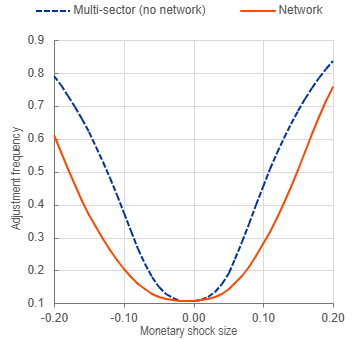
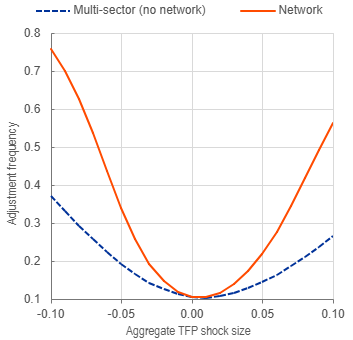
Notes: Panel a) depicts the frequency of repricing in the new model (red solid line) and in the same model but without networks (blue dashed line) as a function of the size of demand shocks, such as monetary interventions. The new model exhibits dampening of the repricing frequency in response to demand shocks. Panel b) displays the frequency of price changes in the same two models for given aggregate total factor productivity (TFP) shocks. In response to such supply shocks, the frequency is amplified in the new model.
In our model, these cascades grow disproportionately when the shock is large. A minor supply disruption produces small price changes and limited knock-on effects. But a major disruption – such as a large fall in productivity or a sustained jump in global commodity prices – can set off a wave that washes over much of the economy. This helps explain why inflation rose so quickly in recent years even though underlying economic conditions changed only gradually at first.
We applied this model to the euro area, building a detailed representation of the economy with almost 40 sectors linked through realistic input-output relationships. We fed in the post-pandemic shocks after 2020: surging demand following the reopening of the economy, reduced labour supply and steep increases in global food and energy prices. Unlike models that ignore production networks and assume mechanical repricing, our model reproduced both the sharp rise in inflation, to around 11%, and the unusually rapid rate of price adjustments by firms. Simpler models predict too little inflation or fail to reproduce the joint movement in inflation and price-adjustment frequency (see Chart 2).
Tailored tools can spot potential supply-side surges
For policymakers, this means understanding inflation requires more than monitoring aggregate indicators. It requires paying attention to the structure of supply chains and to which sectors act as crucial suppliers for the economy. Price hikes in sectors that deliver essential inputs to many others – energy being the classic example – can trigger broad-based and persistent inflation, even when demand conditions are moderate.
Chart 2
Inflation and the frequency of price changes: models versus data
(inflation: percentage points, annualised; frequency: fraction)
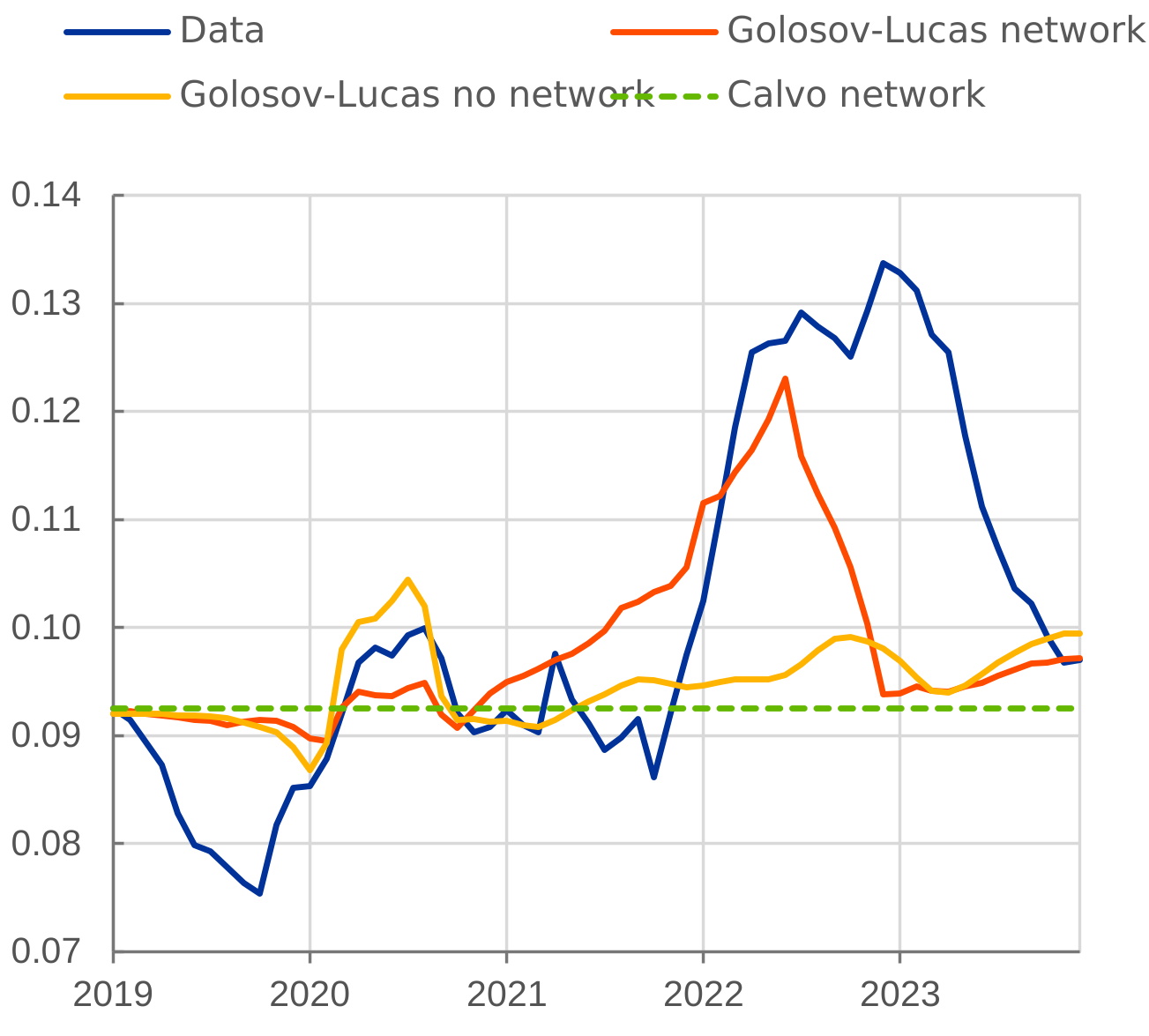 | 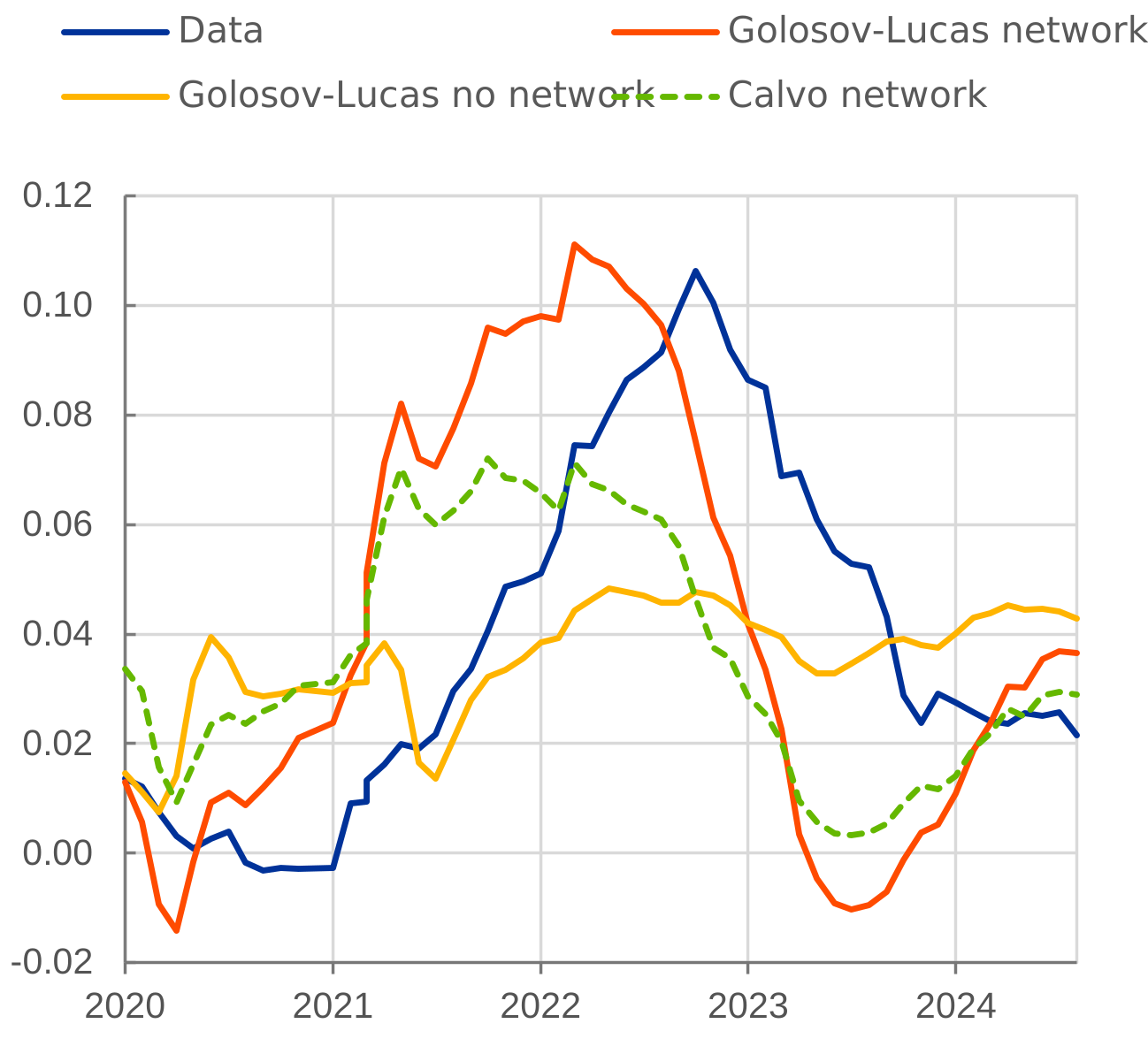 |
Notes: Panel a) depicts the frequency of repricing in the data (blue solid line) and according to three models – the standard (Calvo, 1983) model with a constant repricing frequency (dashed green line), the state-dependent model but without networks (yellow line); and the more realistic state-dependent model with networks (solid red line). Panel b) displays actual inflation in the data and as predicted by the same three models.
The findings also challenge the conventional view that monetary policy is largely ineffective in models with “menu costs”, i.e. where adjusting prices costs firms money. Once the structure of the production network is taken into account, monetary policy can in fact have strong effects on the real economy. Demand-driven shocks see muted price adjustment and strong real GDP responses, which implies that monetary loosening or tightening can stimulate or restrain the economy without necessarily generating excessive inflation or deflation.
Perhaps the most important lesson from our study is that large shocks cannot be analysed with the tools used for small fluctuations in normal times – you can’t dig a well with a teaspoon. Models that assume very small changes can be misleading when shocks are large, or concentrated in an important sector, or when supply chains transmit disturbances very unevenly. Standard modelling tools would have struggled to predict or explain actual euro area inflation in 2021-23.
The case for a supply-side “early warning system”
Inflation can rise sharply not only because demand is strong but also because pricing cascades through supply networks can magnify price spikes from upstream industries. We find that the post-pandemic inflation surge was not driven by greedy firms or overly expansionary monetary policy, but by unexpected price shocks cascading through a tightly connected production network.
As the interdependencies in the global economy are becoming increasingly complex, paying close attention to these mechanisms is essential for understanding future inflation risks and designing effective policy responses. Central banks need tools incorporating sectoral linkages and state-dependent pricing to anticipate waves of supply-side surges in prices.
References
Acemoglu, D., Carvalho, V.M., Ozdaglar, A. and Tahbaz‐Salehi, A. (2012), “The Network Origins of Aggregate Fluctuations”, Econometrica, Vol. 80(5), pp.1977-2016.
Calvo, G. (1983). “Staggered Prices in a Utility-Maximizing Framework. Journal of Monetary Economics, 12(3), 383-398.
Ghassibe, M. and Nakov, A. (2025), “Business Cycles with Pricing Cascades”, CEPR Discussion Papers, No 20605.
Golosov, M. and Lucas, R.E., Jr. (2007), “Menu Costs and Phillips Curves”, Journal of Political Economy, Vol. 115, No 2, pp. 171-199.
This article was written by Anton Nakov (Directorate General Research, European Central Bank) and Mishel Ghassibe (Centre de Recerca en Economia Internacional, Universitat Pompeu Fabra and Barcelona School of Economics). The authors gratefully acknowledge the comments of Zoë Sprokel and Alexander Popov. The views expressed here are those of the authors and do not necessarily represent the views of the European Central Bank or the Eurosystem.