


- INTERVIEW
Interview with Politico
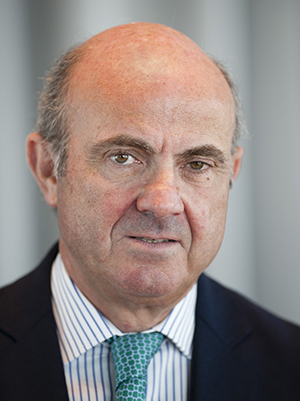
Interview with Luis de Guindos, Vice-President of the ECB, conducted by Kathryn Carlson, Geoffrey Smith and Johanna Treeck
15 January 2026
What is the importance in your opinion of what happened in the United States on Sunday?
I will not go into the full details of this concrete case, but I can make the following general statement: independence in central banking gives rise to the best outcome in terms of inflation and in terms of interest rates. It’s quite clear that if the central bank is not independent, at the end of the day, monetary policy becomes a sort of tool at the service of fiscal policy, meaning that it loses the real perspective of monetary policy – that is, to fight inflation. Simultaneously, an independent central bank is much more credible, and this also has consequences in terms of interest rates. If you look at the yield curve, the yield curve for an independent central bank is always below that of a non-independent one.
And I think that Mr Powell is a very good professional and he has been a very good Chair of the Federal Reserve System. It is very important for all of us that the principle of central bank independence is also applied to the Federal Reserve.
What would be the implications for global markets if the investors lose trust in its independence?
I do not want to prejudge what is going to happen or speculate in that respect. But, again, central bank independence is something that is important for markets in processing how inflation will be kept under control. It is also positive for households and corporates because the level of interest rates set by a credible, independent central bank will be lower than the level set by a non-independent one.
Turning to a related point, the Federal Reserve has had a dominant role in safeguarding global financial stability for the last few decades. Do you think, in view of what has happened in Venezuela, in view of what is being said about Greenland, and now in view of what is happening at the Fed, that the ECB can continue to trust the United States completely as a partner, especially when it comes to supplying the world with dollars in a crisis?
I can assure you that, so far, our cooperation with the Federal Reserve has been normal, business as usual. Swap lines between the Fed and other central banks and the delivery of dollars are positive for financial stability on both sides of the Atlantic and that’s why we believe that cooperation will continue.
But we see where outsourcing Europe’s military security has led us; would you accept that the ECB cannot afford to outsource financial security and financial stability to the United States to the same degree that it has in the past?
First of all, financial stability in the euro area is in the hands of Europeans, of the ECB. The United States is a large market, a large jurisdiction, but the main player in terms of guaranteeing stability in the euro area is the ECB, plus the European Commission. Having said that, it is quite clear – and this is now the consensus in Europe – that we must become more independent, more autonomous. Defence is a very clear example, as are cloud services, artificial intelligence and global means of payment. These are areas where we believe that we should be more independent because the paradigm has changed, the attitude of the United States is different. Europe has started to, and is also going to, react to that. But in terms of cooperation with the Federal Reserve, the ECB’s intention is to continue cooperating as intensively as in the past. It’s in the interest of everybody.
How much progress is the ECB making in intensifying cooperation with other central banks by expanding its network of liquidity lines to reduce reliance on the dollar?
That we want to cooperate with other central banks besides the Federal Reserve has nothing to do with any sort of mistrust. It has been always the case. Swap lines and repo lines, we believe, are potentially beneficial instruments to increase the international role of the euro, but we have not taken any concrete decisions yet. Still, to enhance the international role of the euro, what will be key is doing our homework in the European Union: completing the Single Market, the capital markets union, the banking union and the simplification programmes put forward by the European Commission to reduce unnecessary bureaucratic burdens. These are the kind of things that we have to do. Swap lines and repo lines are only a part of that, and I would say that it’s not the most relevant one.
There have also been reports of other countries talking about pooling their dollar reserves so that they don’t need to rely on President Trump’s, in the case of a dollar shortage. Are talks on that taking place?
We have not discussed anything in that regard, neither in the Executive Board nor in the Governing Council.
There seems to be a sense that the Governing Council recommendations on simplification were a missed opportunity. Is that fair? Other jurisdictions around the world are reducing capital requirements, but the ECB chose not to. Why was that?
The reason is very clear: we believe that the level of capital held by European banks is the correct one. There are two elements to that belief. The first is that capital levels are not restrictive. The level of capital requirements, according to our bank lending survey, isn’t imposing any sort of limitation on funding the economy. Second, the level of capital and the solvency of European banks is one of few competitive advantages that Europe has over other jurisdictions at this time. There was some turmoil in some US regional banks and problems with Credit Suisse, but we have not seen any accident in Europe so far. We believe that this is the consequence of both the level of capital and the quality of European supervision.
Isn’t it inconsistent to warn constantly about risks in the non-bank sector and then to refuse to make it cheaper and easier for banks to bring those risks back to somewhere where you can monitor them better?
The links between banks and non-banks are something we are monitoring very closely, because they are a potential source of financial instability. But, again, given that there are geopolitical risks, with potential fiscal policy implications in the future, or high market valuations, there are reasons to maintain the solvency of the banks and the level of capital, especially as we firmly believe that the level of capital is not a constraint on lending today.
What sense do you have of how the European Commission will incorporate the Governing Council’s recommendations in its final report later this year?
We will have discussions with the Commission before they publish their report. The ECB has presented the different lines of action to simplify the bureaucratic administrative burden for European banks – in terms of the capital stack, regulation, supervision and reporting. But the Commission will have to go into the details, as it is their report. We will continue communicating but we do not want to intrude on the completion of the Commission’s work.
Do you think we’re in a situation now where the Commission, for political reasons, has more risk appetite in the banking area than the ECB? We’ve already seen on securitisation that the ECB was slightly more conservative in its position on how that reform should look…
Well, the ECB is responsible for financial stability in the euro area, and it is also the banking supervisor. Therefore, our approach is cautious. Whether the European Commission is going to accept more or less risk is something you have to ask the Commission.
How would you feel about it drawing up a new omnibus bill for financial services?
I am in contact with the Commissioners, and I think they understand perfectly the high-level recommendation approach that we have used. We will continue discussing with them and we are of course open to further cooperation.
There was a lot of concern in the industry that your proposals on the treatment of Additional Tier 1 (AT1) capital is going to raise banks’ funding costs. What can you do to ensure that it doesn’t?
The reaction of the market when we published our recommendations was close to zero. But markets understand perfectly that we have put forward two alternatives: the first is that only equity should be part of the minimum capital requirement, and the second is to make AT1 more similar to equity. This second proposal had more support in the Governing Council than the first one. As you know, with AT1 you have different elements (the coupon, the possibility of having a call by the issuer or the threshold that triggers the conversion into equity) that could be modified to give it a better loss absorption capacity in the case of a crisis or problem in the banking industry.
The other issue where your recommendations caused a bit of disappointment was the failure to address what the industry sees as a widening gap between minimum requirements and supervisory expectations. How do you stop this trend towards mission creep?
We are not proposing to lower the capital level, the solvency and the resilience of European banks – and we are not proposing to increase the level of capital either. If there is any sort of redundancy or overlap in terms of capital, then for sure we will try to make recommendations to remedy that. But the supervisors’ decisions don’t always lead to an increase in the level of a bank’s capital; sometimes they also lower capital requirements.
Point taken, but on an aggregate level the numbers seem to be going up...
But, again, on aggregate terms, how do you actually explain the positive evolution in the valuation of European banks? Because it is really positive, even in comparison with the United States. The gap between the price-to-book valuations of EU and US banks has almost been bridged. And this is not the assessment of the supervisor, it is the assessment of the markets. Before the pandemic, for instance, the return on equity of European banks was around 4% and now is above 10%. Simultaneously, the cost of equity – the other variable that you have to bear in mind – has been quite stable.
If you ask banks, they will always talk about capital – but capital is not the main element, in my view. What we want to do with this simplification effort is to reduce the unnecessary burden in the relationship between the supervised entities and the supervisors. This involves changes in, for instance, the design of stress testing or capital buffers. And also, very importantly, changes in reporting. We are proposing a single channel of communication between banks and supervisors to avoid the different avenues in data submissions and requests that we see now. The actions we propose will reduce and simplify the framework, and they imply legislative changes. At the same time, ECB Banking Supervision has presented its own report, with some actions being implemented already – and others in the pipeline – for which no modification of legislation is required.
Does that mean that banks can look forward to their supervisory fees no longer rising faster than inflation?
That’s a different question. But that evolution has also moderated recently.
We would still like to have your thoughts a little bit on your successor as well because there are a lot of candidates in the race. What do you see as the most important qualifications? Is it having well established ties in Brussels already? Is it experience as a central banker? Or do you think it’s important to have a more balanced geographical representation on the Executive Board?
All the characteristics you have mentioned are important. I think that knowing how the European institutions work can sometimes be an advantage. Something that I also think is important: central bankers cannot live in an ivory tower and this is becoming more and more obvious. For that, it helps to have a broader view on how monetary policy and financial stability interact with other parts of economic policy. All six candidates for the ECB vice-presidency are very good and they have the right backgrounds.
But there are no women.
I agree that is unfortunate.
What does that mean going forward? I mean, the key question is that Isabel Schnabel has made herself available [for the presidency]: what’s your reading of that situation? Would she legally be allowed to take another term?
President Lagarde was clear on this in the last press conference. She indicated that in a couple of cases the legal advice was that it was not compatible. I’m not a legal expert but I think that precedents are important in life. In any case, the replacement of the President is not going to happen over the next two months. It is going to happen in two years’ time. I know that people start to make calculations. But remember what happened with the replacement of Mario Draghi: Christine Lagarde was not one of the original candidates. This kind of discussion is premature.
OK, but you would agree that if there is no female Vice-President, you do need at least two women on the Executive Board, if not more?
Three is better than two.
You leave the ECB as the highest-ranking Spaniard to have held office there. How long do you expect to keep that record?
(Laughs) I don’t know! As long as the next one is a supporter of Atlético Madrid, all fine for me.
Ευρωπαϊκή Κεντρική Τράπεζα
Γενική Διεύθυνση Επικοινωνίας
- Sonnemannstrasse 20
- 60314 Frankfurt am Main, Germany
- +49 69 1344 7455
- media@ecb.europa.eu
Η αναπαραγωγή επιτρέπεται εφόσον γίνεται αναφορά στην πηγή.
Εκπρόσωποι Τύπου